
*Blink… blink…blink*
The blinking line on the blank page is the bane of any writer’s job. It sits there, taunting you.
It is taunting me right now.
But what if we took it as an invitation to just write, get what we want to say out? Then edit.
Then press send.
Without the drama of endless rewrites and drafts. Without the laboring over word choice.
Yes, there is a science to the “correct headline” or the best opening hook.
You’ve been staring at that newsletter draft for an hour. You’ve rewritten the opening three times. Changed the headline twice. You’re pretty sure the third paragraph needs work, but you can’t figure out why.
Here’s what’s happening: you’re editing the life out of it.
And I want to challenge you to try something different this week.
Let’s take a page from the Miles Davis playbook.
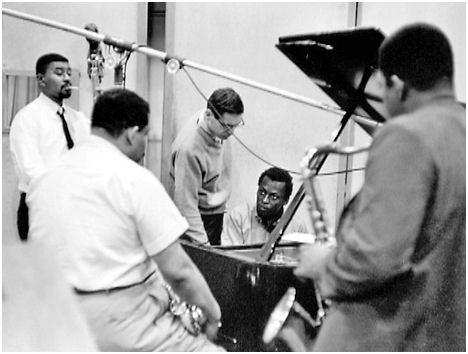
In 1959, Miles Davis conceived the musical settings for his album Kind of Blue only hours before the recording started and arrived with sketches that indicated to the group what was to be played. The group had never played these pieces prior to the recordings, and pianist Bill Evans noted that without exception, the first complete performance of each was a “take”.
Miles explained: “I didn’t write out the music for ‘Kind of Blue,’ but brought in sketches because I wanted a lot of spontaneity in the playing”
The result? The best selling jazz album of all time, consistently chosen by music historians as one of the best albums ever made.
Bill Evans compared their approach to Japanese calligraphy. Japanese calligraphy is a one take process where artists paint on thin parchment with special brushes in such a way that hesitation or correction destroys the work. Erasures or changes are impossible.
Miles’ allowing the musicians to improvise helped them not fall into regular patterns or sound stale.
That same principle applies to your writing voice. Sometimes the first take is the best one.
Why Over-Editing Kills Your Voice
When Miles Davis recorded his follow-up album, Sketches of Spain, it demanded many hours of takes and re-takes. The opposite of the first-take concept of Kind of Blue. Both albums were successful, but Kind of Blue became legendary.
The difference? Spontaneity.
Every time you rewrite that opening paragraph, you’re sanding off the edges that make it sound like you. You’re removing the “imperfections” that actually make it human.
Remember, marketing should be human. Robot writing isn’t authentic writing.
First draft: “This newsletter thing is harder than I thought. Here’s what I learned the hard way this week.”
After three rewrites: “This edition explores insights gleaned from recent experiences in newsletter composition and distribution.”
See what happened? You turned a human voice into corporate – or dare I say AI – mush.
The First-Take Writing Method
Here’s how to capture your best voice before you edit it away:
- Set a timer. Give yourself 30 minutes to write the entire newsletter. No stopping. No editing. Just write like you’re talking to one person over coffee. (I am doing this right now.)
- Don’t outline. Miles would “speak” the charts, giving sketches of the scales over which players would solo. You need a basic structure, like an idea, a point, maybe a story, but don’t script every word. This is where templates are helpful.
- Record yourself first. If the blinker is too much pressure, try talking through what you want to say into your phone. Then transcribe it. You’ll be amazed how speaking off the top of your head gives you more clarity.
- Edit for clarity, not personality. Fix typos. Cut rambling. But don’t “professionalize” your voice. If you naturally start sentences with “And” or “But,” keep them (how many times have I done this so far?).
- Trust the first take. Not every sentence needs to be perfect. Referring back to Japanese calligraphy, did you know artists must practice allowing ideas to express themselves through their hands so directly that deliberation cannot interfere? Something to think about.
The Newsletter That Writes Itself
Here’s what happens when you stop over-thinking:
You sit down. You have something to say. You write it the way you’d say it to a friend. You do a quick edit for clarity. You hit send.
That’s it.
No three-day revision process. No committee review. No watering it down until it sounds like it could’ve been written by anyone.
Miles Davis wanted to capture the musicians’ spontaneity and he wanted to capture it on the first take. That urgency, that freshness, that sense of discovery – that’s what made people feel something.
Your writing should do the same.
No rewrites. No “sleeping on it.” (I am notorious for wanting to do that) No asking three people for feedback.
Just capture the spontaneity before you edit it away.
Will it be perfect? No.
Will it sound like you? Absolutely.
And that’s what people actually want to read.
Why This Actually Matters
Miles Davis wouldn’t have had spontaneity any other way. The real question was how he balanced the familiar with the unfamiliar to achieve what he was looking for.
Your audience don’t need another perfectly polished, professionally edited, committee-approved piece of content. They need something that feels alive. Something that sounds like it came from an actual human who has thoughts and opinions and…personality.
Kind of Blue wasn’t the most technically perfect album ever recorded. But it was the most human. The most felt. The most memorable.
Your newsletter can be too.
Stop trying to make it perfect. Make it real.